Do we work to live? Or do we live to work?
For most of us who are not economically threatened and benefiting from the hard work of our parents which have allowed us to live relatively comfortably as well as having a good education, we do not really have to worry so much about bringing home the extra income at this very moment as did our parents when they were our age. That's the parameter for the rest of this article to make sense.
In view of this, we should be aiming to work in sectors or jobs which we enjoy rather than finding one for the sake of it. Money proves to be a big factor in which job you pick but I think that if you are earning tons of it but you don't enjoy what you do and you dread every day which you have to work then truly it is not worth spending a lifetime on. When you weigh money against happiness, happiness wins hands down provided you are able to get by. Of course, finding a job you love which pays well is just having your cake and eating it which is what some of the richest people in the world have. There are so many millionaires and billionaires who have enough money for lifetimes and yet they are still working in the same job which they have been at for the past few decades. At some point, it's no longer the money that drives you but your personal goals as well as your satisfaction. It's something like a return on equity rather than an earnings per share.
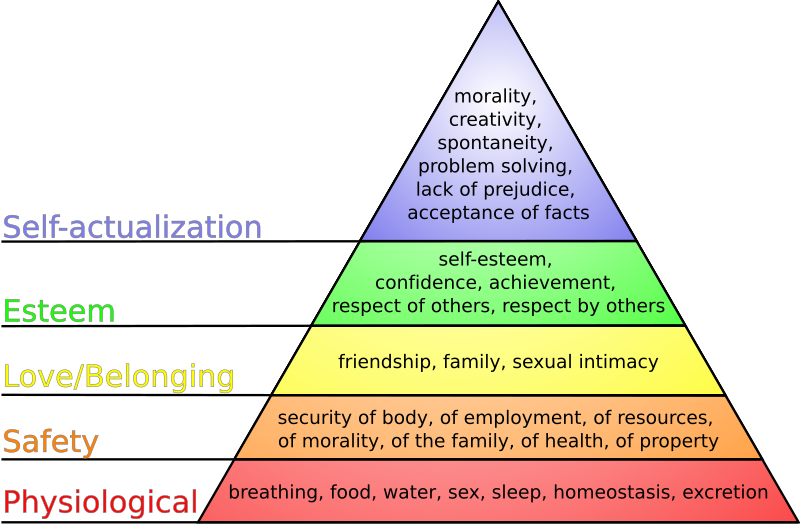
Well, if you have yet to hear of this, here's Maslow's pyramid of needs. I read about it somewhere some time back.
http://en.wikipedia.org/wiki/Maslow
*The pyramid is a general trend and not all encompassing for every single individual on the planet
Money lends itself most up till safety thereafter it can help in love/belonging depending on how it's used and possibly esteem by virtue of the fact that you are successful (in monetary terms at least). It, however, stops there. The top of the pyramid is something money cannot buy. Basically, self-actualization means for a person to realise his full potential as a human being after the rest of his needs have been satisfied. It is, in effect, the pursuit of happiness.
I think this post and the last post are pretty much in opposite ends of the spectrum but we need to recognise the importance and limitations of money. Yet, like I said, if you have to play money off against happiness, happiness will probably win eventually.
For most of us who are not economically threatened and benefiting from the hard work of our parents which have allowed us to live relatively comfortably as well as having a good education, we do not really have to worry so much about bringing home the extra income at this very moment as did our parents when they were our age. That's the parameter for the rest of this article to make sense.
In view of this, we should be aiming to work in sectors or jobs which we enjoy rather than finding one for the sake of it. Money proves to be a big factor in which job you pick but I think that if you are earning tons of it but you don't enjoy what you do and you dread every day which you have to work then truly it is not worth spending a lifetime on. When you weigh money against happiness, happiness wins hands down provided you are able to get by. Of course, finding a job you love which pays well is just having your cake and eating it which is what some of the richest people in the world have. There are so many millionaires and billionaires who have enough money for lifetimes and yet they are still working in the same job which they have been at for the past few decades. At some point, it's no longer the money that drives you but your personal goals as well as your satisfaction. It's something like a return on equity rather than an earnings per share.
Well, if you have yet to hear of this, here's Maslow's pyramid of needs. I read about it somewhere some time back.
http://en.wikipedia.org/wiki/Maslow
*The pyramid is a general trend and not all encompassing for every single individual on the planet
Money lends itself most up till safety thereafter it can help in love/belonging depending on how it's used and possibly esteem by virtue of the fact that you are successful (in monetary terms at least). It, however, stops there. The top of the pyramid is something money cannot buy. Basically, self-actualization means for a person to realise his full potential as a human being after the rest of his needs have been satisfied. It is, in effect, the pursuit of happiness.
I think this post and the last post are pretty much in opposite ends of the spectrum but we need to recognise the importance and limitations of money. Yet, like I said, if you have to play money off against happiness, happiness will probably win eventually.